Fundamental Tax Profiles and Structural Distinctions
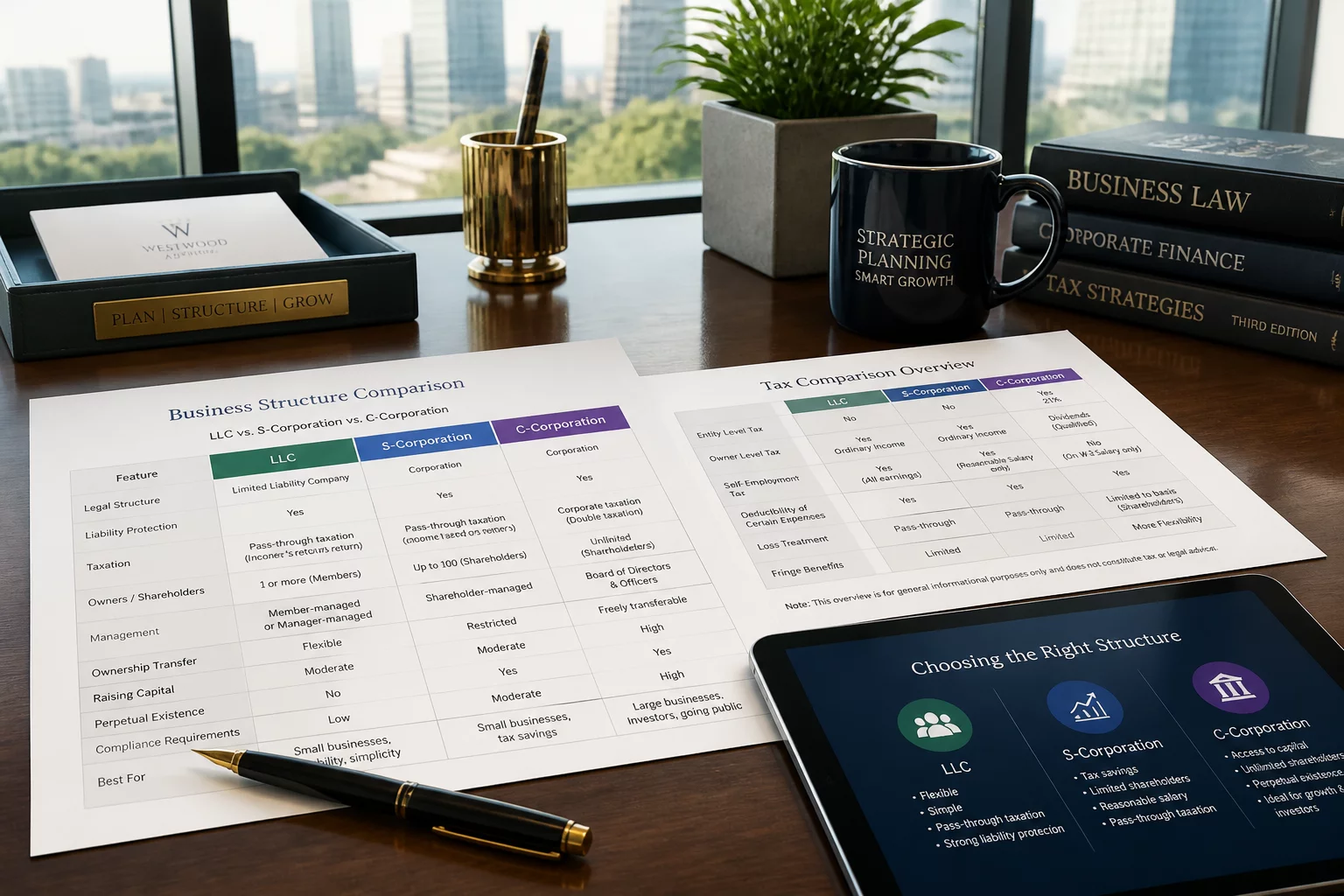
Selecting a corporate entity dictates direct federal tax burdens, mandatory state compliance filings, and personal asset insulation. Many small business founders initially launch as single-member or multi-member Limited Liability Companies due to minimal administrative overhead. However, as enterprise revenues scale, regular pass-through self-employment taxes can create an unexpectedly steep fiscal drag.
Electing S-Corporation classification enables owner-operators to divide net operational cash flow into standard W-2 executive compensation and pass-through shareholder dividend distributions. This structure legally moderates Medicare and Social Security tax exposure on the distribution component. Meanwhile, traditional C-Corporations confront separate entity taxation at the 21% flat federal rate, yet remain essential for ventures seeking institutional venture funding, issuing multiple stock classes, or leveraging Section 1202 Qualified Small Business Stock tax exclusions.
Structural Comparison Benchmarks
- Default Tax Regime
- Pass-Through vs. Flat Corporate
- Self-Employment Tax Rate
- 15.3% on Net vs. W-2 Salary Only
- Ownership Restrictions
- 100 Shareholder Limit for S-Corps
- Qualified Stock Exclusion (Sec. 1202)
- Exclusive to Eligible C-Corps
Navigating Transition Windows and Election Deadlines
Timing an entity transition demands strict adherence to IRS calendar deadlines alongside state statutory filings. Submitting IRS Form 2553 for an S-Corporation election must take place within two months and fifteen days of the beginning of the tax year, or during the tax year immediately preceding the intended effective date. Missing this narrow statutory window postpones potential distribution tax advantages by an entire annual accounting cycle unless relief for late elections is successfully petitioned.
Key Decision Directives
- Model anticipated net operating income before adopting S-Corp status to ensure distribution tax reductions comfortably outpace corporate payroll and compliance fees.
- Preserve formal corporate governance records and separate banking transactions regardless of entity size to shield owners from piercing the corporate liability veil.
- Account for state-specific franchise taxes and local pass-through entity tax deductions before finalizing structural alterations across jurisdictions.
- Confirm long-term capitalization objectives early because venture capitalists and institutional funds universally require standardized Delaware C-Corporation governance.
Corporate architecture dictates financial resilience. Structuring is not a static setup requirement, but a dynamic tax-optimization discipline that must adapt to corporate balance sheet evolution.